Getting your boat tied up right, especially a catamaran, can feel like a puzzle sometimes. It’s not just about throwing a rope; it’s about making sure your boat stays put, safe and sound, no matter what the water or wind decides to do. This guide is all about making that happen. We’ll break down how to handle catamaran mooring, from the basics to tricky situations, so you can pull into any spot with confidence. Think of it as your go-to for making sure your boat stays put when you’re ashore.
Key Takeaways
- Catamaran mooring is about more than just tying up; it’s about keeping your boat stable, secure, and protected from damage.
- Having the right gear, like fenders and good lines, makes a big difference, especially if you’re trying to dock by yourself.
- There are different ways to tie up a catamaran, like alongside a dock or stern-to, and each needs its own approach.
- Wind, currents, and tides can mess with your docking, so knowing how to adjust your plan is super important.
- Clear talking with your crew and knowing basic knots, like the cleat hitch, are must-haves for safe catamaran mooring.
Understanding Catamaran Mooring Fundamentals
Defining the Mooring Maneuver
So, what exactly is mooring? At its simplest, it’s the process of parking your boat and making sure it stays put when you’re tied up to a dock, a buoy, or even another boat. But there’s more to it than just tying a few ropes. It really boils down to three main ideas: keeping the boat steady, making sure it’s firmly attached, and protecting it from damage. Think of it as giving your boat a safe parking spot, no matter what the weather or water decides to do.
Key Concepts: Stabilizing, Securing, and Protecting
Let’s break down those three core ideas. Stabilizing means your catamaran isn’t rocking around excessively due to wind, waves, or current. It’s about keeping it relatively still. Securing is about making sure those lines are tight enough and attached properly so the boat doesn’t drift away or bump into anything it shouldn’t. Finally, Protecting involves using things like fenders to prevent scratches and dings on your hull from the dock or other boats. It’s a three-pronged approach to boat care.
The Importance of Proper Mooring
Why all this fuss about mooring? Well, it’s pretty important for a few reasons. First off, safety. A boat that breaks loose can cause a lot of trouble, not just for you but for others in the marina too. Then there’s protecting your investment; catamarans aren’t cheap, and a bad mooring job can lead to expensive repairs. Plus, honestly, it just gives you peace of mind. You want to be able to relax and enjoy your time ashore, not worry about your boat.
- Safety: Prevents unexpected movement that could injure people or damage the boat.
- Protection: Guards your catamaran’s hull and equipment from impacts and abrasion.
- Peace of Mind: Allows you to enjoy your stopover without constant worry.
- Neighborly Conduct: Keeps your boat from obstructing other vessels or marina facilities.
Mooring isn’t just a final step after a day’s sail; it’s a skill that needs attention every time you tie up. Getting it right means your boat stays safe and sound, ready for your next adventure.
Understanding how your boat interacts with its environment and the mooring point is the first step. This involves looking at your boat’s shape and weight, the type of dock or mooring structure you’re using, the quality and length of your lines, and the placement of your fenders. Each element plays a part in the overall success of the maneuver. For more on boat mooring checklists, you might find this guide helpful.
Essential Equipment for Catamaran Mooring
Alright, let’s talk about the gear you absolutely need to have on hand when you’re bringing your catamaran into a slip or tying up for the night. It’s not just about having ropes and cushions; it’s about having the right ones and knowing how to use them. Think of this as your checklist for peace of mind.
Selecting Appropriate Fenders and Lines
When it comes to fenders, size really does matter. You want fenders that are big enough to keep a good distance between your boat’s hull and the dock or other vessels. Too small, and they won’t do much good when a wave slaps you against the pilings. For catamarans, with their wider beam, you might need more fenders than a monohull, and you’ll want to position them strategically along the hulls. Don’t forget to check their pressure; a soft fender is about as useful as a screen door on a submarine.
Mooring lines are your boat’s lifeline to the dock. You’ll want a few sets, and they should be in good shape. Look for lines made of materials like polyester; they hold up well against the sun and general wear and tear. Nylon is stretchy, which can be good for absorbing shock, but it can degrade faster. Make sure you have enough length – a good rule of thumb is to have lines at least as long as your boat, with spring lines being even longer, maybe 1.5 to 2 times your boat’s length. This gives you flexibility when docking. Having a variety of line diameters is also smart, matching them to your boat’s size and weight.
Utilizing Mooring Aids for Solo Docking
Docking a catamaran by yourself can feel like a juggling act, but the right gear makes it way less stressful. Tools like a dock hook can be a lifesaver. You can use it to grab a dock line from a distance and pull it aboard without having to get too close or lean precariously over the side. This is especially handy when you’re the only one on deck. Having a good set of fenders ready to deploy quickly is also key. Some sailors even use fender boards, which are planks that distribute the pressure of fenders over a larger area of the hull, protecting it from sharp edges on docks.
Mooring aids aren’t just for beginners; they’re smart tools for any skipper looking to simplify the docking process and reduce the risk of damage. They allow for more controlled approaches and easier line handling, especially when you’re working alone.
Maintaining Mooring Lines: Inspection and Care
Your mooring lines are constantly under stress from the elements and the movement of your boat. Because of this, regular inspection is a must. Look for any signs of fraying, especially near the ends where they tie off or chafe against the dock. Check for any cuts or worn spots. If you see any damage, it’s time to replace the line. Don’t wait until it fails! After each use, especially if you’ve been in saltwater, give your lines a good rinse with fresh water. This helps wash away salt and dirt that can degrade the fibers over time. Store them properly, coiled neatly and out of direct sunlight, to prolong their life. Keeping your lines in top condition is a simple but vital part of safe catamaran rigging.
Here’s a quick rundown on what to look for:
- Fraying: Check the entire length, paying close attention to ends and any points of chafe.
- Cuts and Nicks: Even small cuts can weaken a line significantly.
- Discoloration: While not always a sign of weakness, significant fading or odd colors can indicate UV damage or chemical exposure.
- Stiffness: Lines that have become unusually stiff might be degrading internally.
- Knots: Ensure any knots used are still secure and haven’t slipped or tightened excessively.
Mastering Catamaran Docking Techniques
Alongside Mooring: A Detailed Approach
Docking alongside a pier is a common scenario, but it requires a methodical approach. The key is a slow, controlled entry. Before you even get close, take a moment to assess the situation. Look at the wind, any current, and how other boats are positioned. This initial look-around helps you plan your approach angle and speed. It’s always better to make a couple of slow attempts than one rushed one that ends badly.
Here’s a breakdown of how to approach it:
- Slow and Steady: Approach the dock at a crawl. You need enough speed to steer, but not so much that you can’t stop quickly if needed. Think of it as moving in slow motion.
- Angle of Attack: If there’s no wind or current pushing you, a nearly parallel approach works. If the wind or current is pushing you towards the dock, you’ll need a slightly wider angle and use your engines to counteract the drift.
- Stopping Point: Figure out where you need to stop. Remember, boats have inertia; they keep moving even after you put the engine in neutral. A heavier catamaran will take longer to stop than a lighter one.
- First Lines: Once stopped, get your first lines secured. Usually, this means a bow line and a stern line, or a spring line, depending on the situation. Getting these secured quickly stops the boat from drifting.
Remember that your catamaran’s wider beam means you have more space to work with, but it also means you need to be more aware of your surroundings to avoid hitting other boats or the dock itself.
Stern-To Mooring: Navigating Mediterranean Style
This style of docking, often seen in the Mediterranean, involves backing into a slip and dropping your anchor. It sounds tricky, and it can be, but with practice, it becomes manageable. The whole process starts well before you reach the dock.
- Anchor Drop: You need to figure out where to drop your anchor. This spot depends on the water depth, your boat’s length, and how much chain you have. The goal is to have enough chain out so that when you back up to the dock, the anchor holds firm.
- Slow Reverse: Once the anchor is set, you slowly back the boat towards the dock. As you back up, you’ll be paying out chain. You want to keep a little tension on the chain to make sure the anchor is digging in and not just dragging.
- Communication is Key: The person on the bow managing the anchor chain needs to talk constantly with the person at the helm. They need to report how much chain is out and if the anchor is holding. The helmsman needs to keep the boat straight while backing up, which is tough because visibility is limited.
Wind and current play a big role here. You might have to make some adjustments to your course as you back down. It’s a maneuver that really tests your crew’s coordination. For more on docking, check out essential safety tips.
Mooring To A Mooring Block: Securing To Submerged Points
Mooring to a block means you’re tying up to a submerged weight on the seabed, usually with a buoy marking the spot. This is common in anchorages where permanent moorings are set up.
- Approach: Motor slowly towards the mooring buoy. You’ll want to approach it heading into any wind or current, if possible.
- Line Preparation: Have your mooring lines ready. You’ll typically need to loop one around the buoy and secure it, or pick up a pennant (a line attached to the buoy) with a boathook and bring it aboard to tie off.
- Securing: Once you have the line secured, you’ll use your engines to position the boat correctly relative to the buoy and then secure your stern lines to keep the boat from swinging too much. This is a good place to practice your cleat hitch.
It’s important to check the condition of the mooring buoy and its lines before committing your boat. Make sure it looks sturdy and well-maintained.
Navigating Challenging Conditions for Catamaran Mooring
Docking a catamaran isn’t always smooth sailing. Sometimes, you’ve got to deal with Mother Nature throwing a curveball. Wind and current are the big ones, and they can really mess with your approach. You need to anticipate how they’ll push your boat and plan your moves accordingly.
Adapting to Wind and Current
When the wind is blowing, it’s going to push your boat sideways. If you’re trying to come alongside a dock, you’ll need to account for this drift. Sometimes, you can use the wind to your advantage, but usually, it just makes things trickier. Currents are similar; they’ll try to sweep you off course. You’ll find yourself constantly making small adjustments with the engines to stay on track. It’s a bit like trying to walk in a straight line on a moving walkway.
- Wind: If the wind is pushing you onto the dock, you’ll need to use your engines to push off slightly as you get close, or use spring lines to control your movement. If it’s blowing you off the dock, you’ll need to approach at a slight angle and be ready to use fenders to absorb the impact.
- Current: A strong current running parallel to the dock can make it hard to slow down. You might need to approach faster than usual and then use your engines in reverse to kill your speed. If the current is flowing towards the dock, you’ll need to fight it with your engines.
- Combined Effects: Often, you’ll have both wind and current working against you. This is where practice really pays off. You’ll need to combine techniques, using your engines and lines to counteract both forces simultaneously.
Dealing with wind and current requires a good feel for your boat’s handling. It’s not just about knowing the theory; it’s about being able to react instinctively when things get a bit wild. Slow and steady is usually the way to go, but sometimes you need a bit more power to fight the elements.
Managing Tidal Variations
Tides can be a real pain, especially if you’re staying for a while. The water level changes, and if your lines are too tight, they can snap. If they’re too loose, your boat could end up banging against the dock or even drifting away. You’ve got to think about how much the tide will rise or fall and adjust your lines accordingly. This is especially important if you’re stern-to mooring, where the stern of your boat might end up quite high or low relative to the dock.
- Line Length: Always give your lines plenty of slack to accommodate the full tidal range. It’s better to have a bit too much slack than not enough.
- Fender Height: You’ll need to adjust your fenders as the tide changes. What was a perfect position at low tide might be useless at high tide.
- Spring Lines: Using spring lines can help manage the fore-and-aft movement caused by tidal changes, keeping your boat centered.
Handling Waves During Docking
Waves, even small ones inside a harbor, can make docking a bouncy affair. They can cause your boat to surge forward and backward unexpectedly, making it hard to control your approach. If you’re dealing with swell, it’s even tougher. You might need to use mooring snubbers, which are like shock absorbers for your lines, to smooth out the ride. Trying to secure your yacht in a harbor during a storm requires using appropriate mooring methods, like strategically crossing mooring lines to distribute forces effectively.
- Slow Approach: The slower you go, the less impact the waves will have.
- Fender Placement: Make sure your fenders are positioned to absorb bumps from any direction.
- Spring Lines: These can be your best friend for controlling movement in choppy conditions.
Crew Roles and Communication in Catamaran Mooring
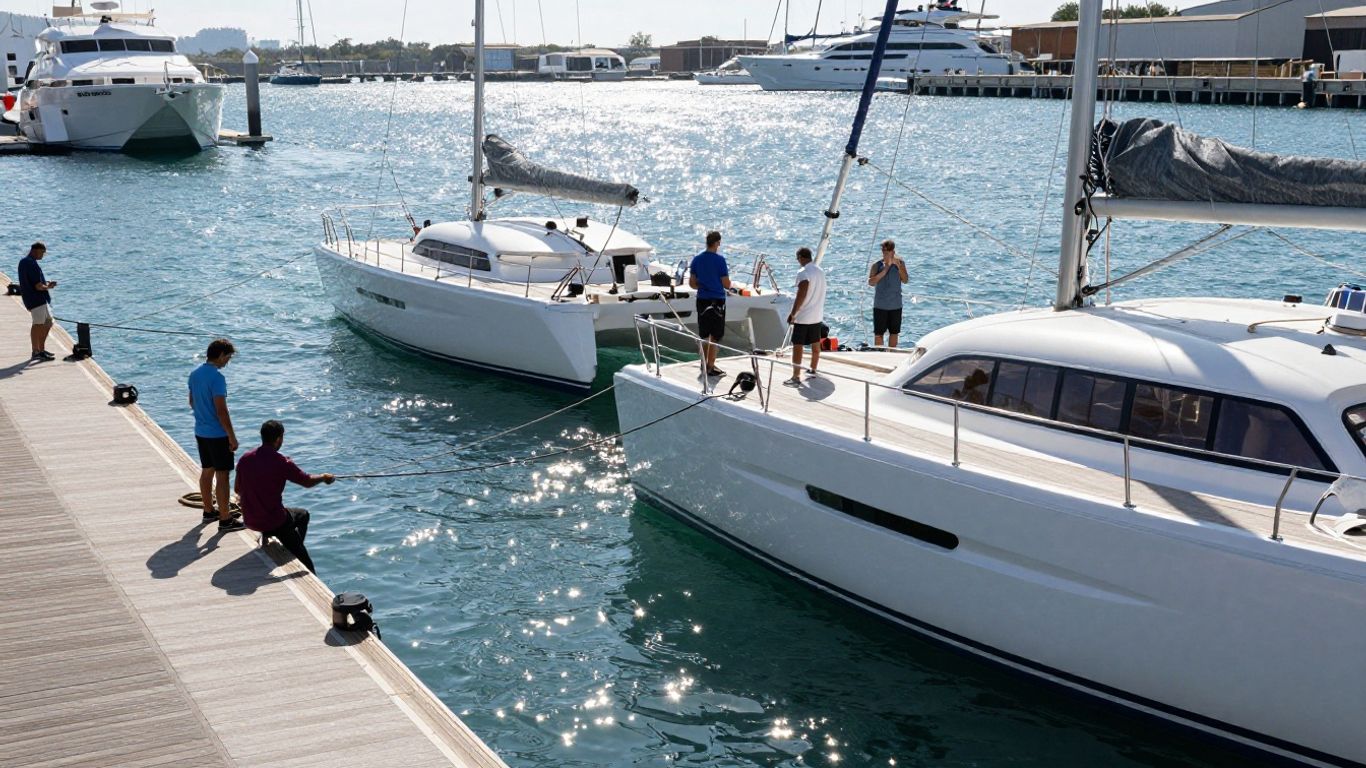
Alright, let’s talk about getting everyone on the same page when you’re bringing that big ol’ cat into a tight spot. Mooring a catamaran isn’t a solo act, even if you’ve got a small crew. It’s all about knowing who’s doing what and making sure everyone’s talking to each other. Clear communication and well-defined roles are the bedrock of a smooth docking maneuver.
Effective Skipper Communication
The skipper, that’s you, the captain, has the final say. Your job is to see the whole picture – the wind, the current, the space you’ve got, and where everyone is. You need to give clear, concise instructions. Think short commands, not long speeches. If you’re dealing with a lot of noise or distance, like on a larger catamaran, walkie-talkies are a game-changer. They let you talk directly to the person at the bow managing the lines or the person at the stern. It makes a huge difference compared to yelling across the deck.
Delegating Tasks to the Crew
Don’t try to do it all yourself. Your crew is there to help, but they need to know exactly what you need them to do. Before you even get close to the dock, have a quick chat. Assign specific jobs: one person on bow lines, another on stern lines, someone managing fenders. Make sure they know where to stand, how to handle the lines, and what to do if something unexpected happens. It’s also good to have a backup plan for each role.
Here’s a quick rundown of common tasks:
- Fender Manager: Responsible for placing and adjusting fenders to protect the hull. Needs to watch for tide changes and adjust fender height.
- Bow Line Handler: Prepares and throws the bow line, secures it to a cleat or bollard. Needs to be ready to adjust tension.
- Stern Line Handler: Similar to the bow handler, but for the stern lines. Often more critical in tight spots.
- Helm/Throttle Control: The skipper, or a designated helmsman, controlling the boat’s movement.
Anticipating Maneuvers and Ensuring Safety
This is where good communication really shines. Everyone on board needs to be thinking ahead. If the skipper calls for a line to be secured, the crew member should already be thinking about how much tension is needed and where the best place to tie it is. It’s about anticipating the next step. For example, if you’re doing a stern-to mooring, like you might see in the Mediterranean, the person on the bow needs to be ready with the anchor and the lines well before the stern is even close to the dock. This kind of teamwork prevents those last-minute scrambles that often lead to mistakes. Remember, safety first – keep fingers clear of lines and cleats, and never stand in a bight of a rope.
Mooring isn’t just about the boat; it’s about the people. A well-briefed crew, where everyone knows their part and can communicate effectively, turns a potentially stressful situation into a controlled operation. It’s about building confidence through preparation and clear roles, making sure everyone feels secure and knows what to expect next.
Common Catamaran Mooring Mistakes to Avoid
Alright, let’s talk about the stuff that can go wrong when you’re trying to tie up your catamaran. We’ve all seen it, maybe even done it ourselves – those moments where a simple docking maneuver turns into a bit of a drama. Avoiding these common slip-ups is key to keeping your boat, and everyone around it, safe and sound. It’s not about being perfect, but about being aware.
Improper Line Tension
This is a big one. You’ve got two main problems here: lines that are too tight or lines that are way too loose. If your lines are pulled drum-tight, they can’t absorb any of the boat’s natural movement from wind or waves. This puts a ton of stress on your cleats and the dock fittings, and honestly, it can cause damage. On the flip side, lines that are too slack let your boat wander around, bumping into the dock or other boats. This can lead to scratches, dents, and a generally uncomfortable ride. Finding that sweet spot where the lines hold you steady but still allow for a bit of give is the goal. It’s a balancing act, for sure.
Rushing the Approach
When you’re coming into a tight spot, it’s easy to feel the pressure and just want to get it done. But speeding up the approach is a recipe for trouble. You need time to assess the wind, the current, and how your boat is handling. A slow, controlled approach gives you the chance to make small adjustments and react to unexpected changes. Trying to rush things often means you’ll overshoot your mark, misjudge distances, or end up in a situation where you have to make sudden, jerky movements. It’s better to take an extra minute to get it right than to spend hours fixing a mistake. Remember those common docking mistakes? Rushing is usually number one on the list.
Insufficient Fender Placement
Fenders are your boat’s bumpers, and if you don’t have enough, or if they’re not in the right spots, your hull is going to take a beating. Think about it: you need enough fenders to cover the widest parts of your boat, especially where it’s likely to make contact with the dock or another vessel. They also need to be at the right height. If a fender is too high or too low, it’s not going to do much good when the boats touch. You’ve got to anticipate how the tide might change things, too. And don’t forget to tie them on securely; a fender that drifts out of place is pretty useless.
It’s easy to get caught up in the mechanics of tying knots and throwing lines, but sometimes the simplest errors, like not having enough fenders or having them in the wrong place, can cause the most damage. Always take a moment to look at your boat from the dock’s perspective before you commit to the final tie-up.
Here’s a quick rundown of fender issues:
- Not enough fenders: Leaves large sections of your hull exposed.
- Incorrect spacing: Creates gaps where the boat can hit the dock.
- Wrong height: Fenders are useless if they’re not at the point of contact.
- Poor attachment: Fenders can move and fail to protect the hull.
Making these kinds of mistakes can lead to some pretty frustrating situations, like the sailing blunders that taught me a lot the hard way. Paying attention to these details makes a world of difference.
Essential Knots for Secure Catamaran Mooring
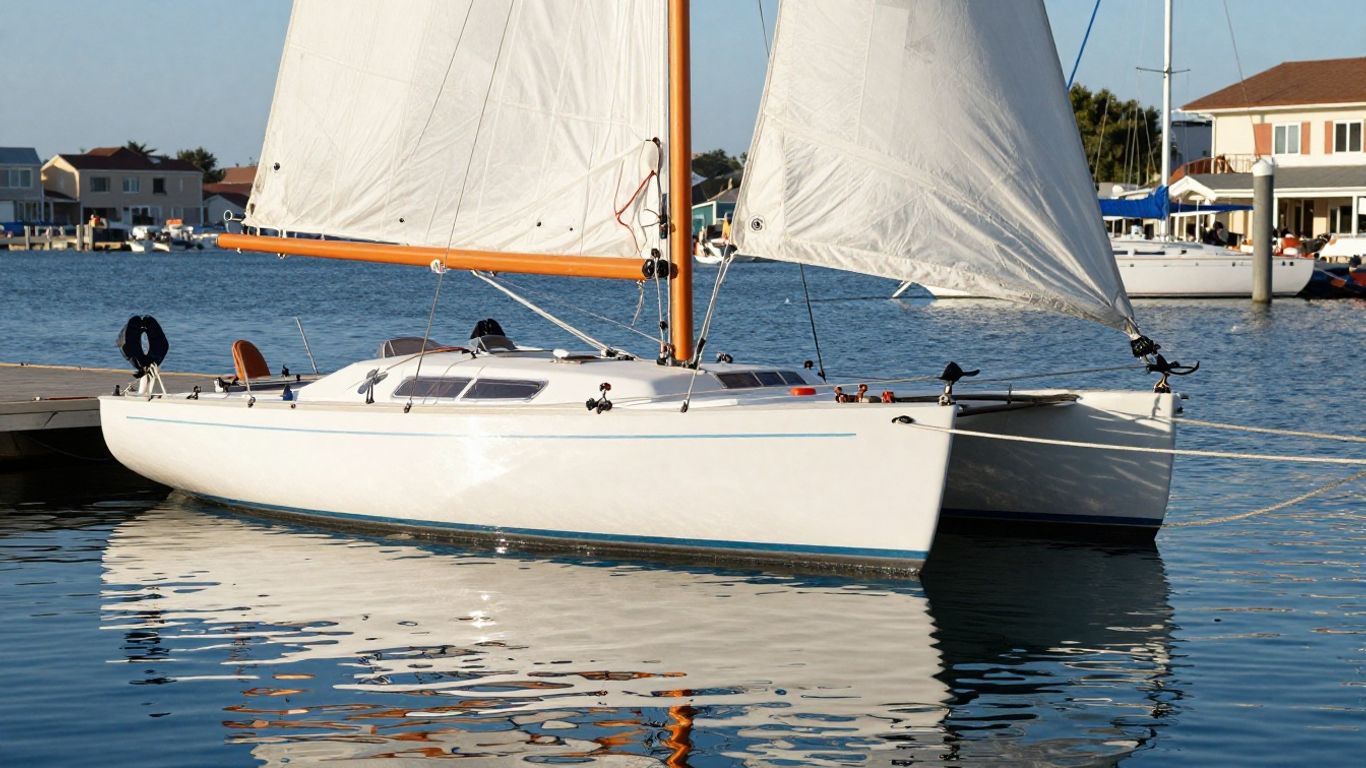
Alright, let’s talk about knots. You can have the best lines and fenders in the world, but if your knots aren’t up to snuff, you’re asking for trouble. It’s not just about tying something; it’s about tying it right, so it holds when you need it to and can be untied when you don’t. For catamaran mooring, having a few key knots down pat is pretty important.
The Cleat Hitch: A Crucial Skill
This is probably the most common knot you’ll use when docking. You’ll be tying your lines to the cleats on your boat and on the dock. Getting this right means your boat stays put. A properly tied cleat hitch won’t slip, even with a lot of strain.
Here’s the basic idea:
- Start with a full turn around the base of the cleat.
- Then, make a figure-eight pattern around the horns of the cleat.
- Finish with a half hitch, but make sure it’s snug and can be easily undone.
It sounds simple, and it is, but doing it quickly and correctly, especially when the wind is pushing you, takes practice. You don’t want to be fumbling around when you’re already close to the dock.
Practicing Knots for Dexterity and Speed
Look, nobody’s born knowing how to tie a perfect bowline in a gale. You have to practice. Seriously, grab a piece of rope and just tie knots. Over and over. Do it while you’re watching TV, waiting for water to boil, whatever. The goal is to get to the point where your hands just know what to do, without you even having to think about it. This is where mastering essential sailing knots really pays off.
- Repetition: Tie each knot at least 50 times. No joke.
- Vary Conditions: Try tying them with one hand, or with gloves on.
- Untying: Practice untying them quickly, especially after they’ve been loaded.
The difference between a good sailor and a struggling one often comes down to how well they can handle their lines under pressure. Knots are a big part of that.
Understanding Knot Strength and Limitations
Not all knots are created equal, and no knot is perfect. Some knots are stronger than others, and some can damage your rope over time. For instance, the bowline is a fantastic knot for creating a fixed loop, and it’s known for being reliable. It’s a go-to for many situations, like securing a line around a piling or a dock ring. The Bowline knot is a classic for a reason.
Here are a few things to keep in mind:
- Rope Type: The material of your rope affects how well a knot holds.
- Load: How much force will the knot be under?
- Wear and Tear: Inspect your knots and lines regularly for any signs of fraying or damage.
Knowing these limitations means you won’t put yourself in a risky situation by relying on a knot that’s not suited for the job. Always check your work before you step away.
Wrapping It Up
So, we’ve gone over a bunch of stuff about getting your catamaran tied up safely. It might seem like a lot at first, but really, it comes down to knowing your boat, having the right gear, and just taking your time. Practicing these moves, whether you’re alone or have a crew, makes a huge difference. Don’t get discouraged if it’s not perfect right away. The more you do it, the easier it gets. Being able to dock smoothly means you can relax and enjoy your time on the water, knowing your boat is secure. Now go out there and practice!
Frequently Asked Questions
What exactly is boat mooring?
Mooring is basically how you park your boat and keep it from moving when it’s tied up to a dock, a buoy, or even another boat. It’s all about making sure your boat stays put safely, no matter what the wind or water is doing.
Why is having the right equipment so important for mooring?
Having the right gear, like sturdy ropes and enough fenders (those cushiony things), is super important. It helps prevent your boat from bumping into things and getting damaged. Special tools can even make it easier to tie up by yourself.
What's the difference between mooring alongside and stern-to mooring?
Mooring alongside means parking your boat parallel to the dock, like you see most often. Stern-to mooring, common in places like the Mediterranean, is when you back your boat into a spot and tie it up with the stern facing the dock, often using the anchor at the front.
How does wind and current affect mooring?
Wind and currents can push your boat around, making it harder to get into place. You need to figure out which way they’re pushing and use that information, along with your boat’s engine and ropes, to control your boat’s movement and get it safely docked.
What are some common mistakes people make when mooring?
People often make mistakes like tying their ropes too tight or too loose, not putting enough fenders out, or approaching the dock too fast. Rushing the process and not paying attention to details can lead to problems.
What are the most important knots for mooring?
The cleat hitch is a really important knot for tying your boat to a cleat on the dock or on your boat. Knowing how to tie it correctly and quickly is a key skill for any boater to keep their boat secure.