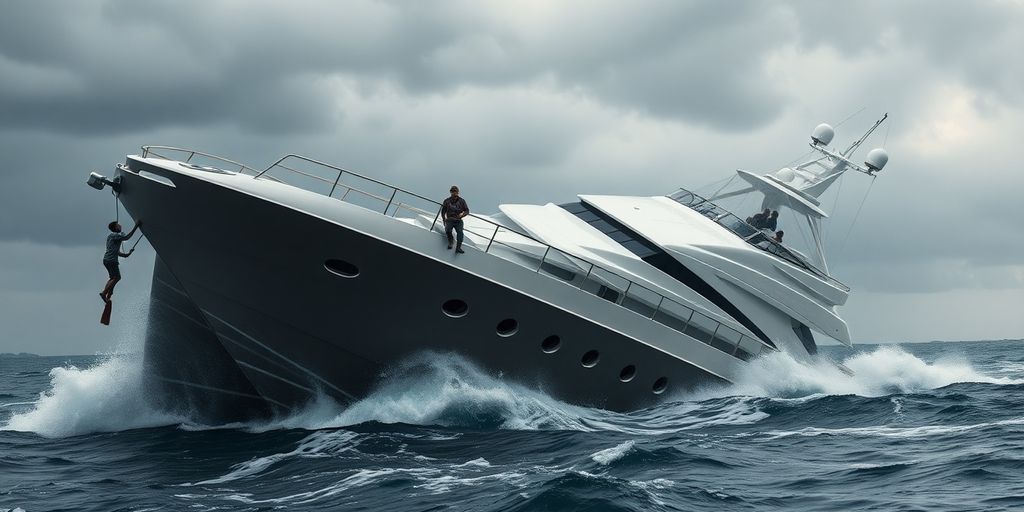
Lately, it seems like we’ve been hearing more and more about yachts capsizing. It’s a pretty scary thought, especially if you love being out on the water. You might be wondering why this is happening, and honestly, there isn’t just one simple answer. It’s a mix of things, from how these big boats are built to the crazy weather we’re seeing. Let’s dig into some of the reasons why yachts capsizing might be on the rise.
Key Takeaways
- The keel’s position is super important for how stable a yacht is, and if it’s pulled up, the boat becomes way less steady.
- Extreme weather, like waterspouts and really strong gusts, can put yachts in situations they just aren’t built for.
- How a yacht is put together, including things like its mast and watertight sections, really affects if it can handle trouble.
- People’s choices and how well the crew is trained play a big part in staying safe when things get rough.
- Changes in the environment, like warmer oceans and more severe storms, are making yachting riskier.
Understanding Yacht Stability and Design
The Critical Role of the Keel in Preventing Yachts Capsizing
The keel is like the unsung hero of a yacht. It’s a weighted fin sticking out from the bottom, and its main job is to stop the boat from tipping over. Think of it like a counterweight. When the wind pushes the boat to one side, the keel’s weight pulls it back upright. Without a keel, a yacht would be much more likely to capsize, especially in strong winds or rough seas. The size and shape of the keel are important factors in determining a yacht’s stability. A deeper keel generally provides more stability, but it also means the boat needs deeper water to sail in. It’s a balancing act that designers have to consider. The ship’s intact stability is paramount for safe navigation.
Impact of Retracted Keels on Yacht Stability
Some modern yachts have retractable keels. This is cool because it lets them go into shallower waters, like harbors or bays, where a fixed keel boat couldn’t go. However, there’s a trade-off. When the keel is up, the boat becomes less stable. It’s like taking the weight off the bottom – the boat is now easier to tip. This means that yachts with retractable keels need to be handled with extra care, especially in bad weather. It’s super important to know the limitations and to make sure the keel is down when you’re out in open water or when there’s a chance of strong winds.
Design Considerations for Modern Yachts
Modern yacht design is a complex thing. Designers have to think about a lot of stuff, not just how the boat looks, but also how it performs in different conditions. Here are some things they consider:
- Hull Shape: The shape of the hull affects how the boat moves through the water and how stable it is.
- Weight Distribution: Where the weight is placed on the boat can make a big difference in stability. Keeping the weight low helps prevent capsizing.
- Sail Area: The size of the sails affects how much power the boat has, but also how much it can be pushed over by the wind.
Yacht design is always evolving, with new materials and technologies being developed all the time. The goal is to create boats that are safe, comfortable, and fun to sail, even in challenging conditions. It’s a tough job, but when it’s done right, the results can be amazing.
The Influence of Extreme Weather Events
It feels like every time you turn on the news, there’s another story about some crazy weather event. And it’s not just on land; the seas are getting wilder too. This raises a big question: are these extreme conditions playing a bigger role in yacht capsizing incidents?
Waterspouts and Their Destructive Power
Okay, so most people know what tornadoes are, right? Waterspouts are basically the same thing, but they happen over water. Instead of kicking up dust, they suck up water, creating this swirling column of mist. While they might seem like a rare occurrence, they’re actually more common than you think, especially in certain areas.
- Waterspouts are most common in late summer and autumn when sea temperatures are high.
- The International Centre for Waterspout Research reported 18 waterspouts off the coast of Italy on one day.
- Waterspouts are hard to detect on radar, so many go unreported.
Waterspouts, while visually impressive, pose a significant threat to yachts. Their unpredictable nature and concentrated force can easily overwhelm a vessel, leading to capsizing or structural damage. It’s important for sailors to be aware of the conditions that favor waterspout formation and to take appropriate precautions when sailing in areas where they are common.
Hurricane-Force Gusts and Yacht Resilience
Imagine being out on the water, and suddenly, you’re hit with a gust of wind so strong it feels like a punch. That’s what hurricane-force gusts can do. They can push a yacht way beyond its design limits, putting incredible stress on the hull, rigging, and sails. One sailor described a "very strong hurricane gust" superyacht likely capsized and struggling to keep his vessel steady. It’s a scary thought.
Are Yachts Designed for Extreme Conditions?
This is the million-dollar question, isn’t it? Are yachts built tough enough to handle the kind of weather we’re seeing more and more of? The truth is, most yachts aren’t designed to withstand the absolute worst-case scenarios. As one expert put it, vessels aren’t designed to be out sailing in winds of 65 to 85 mph. They aren’t designed to sail through tornadoes or waterspouts. It really comes down to a balance between performance, comfort, and safety. You can’t build a tank and expect it to sail like a dream, but you also don’t want a boat that’s going to fall apart at the first sign of a storm.
Here’s a simplified table showing wind speeds and their potential impact on yachts:
| Wind Speed (knots) | Beaufort Scale | Description | Potential Impact on Yachts coded. It’s a constant learning process, and staying informed is the best defense.
Structural Integrity and Material Science
It’s easy to focus on weather when yachts capsize, but what about the boats themselves? The materials they’re made of, how they’re put together, and how well they’re maintained play a huge role. We’re going to look at some key areas where structural problems can lead to disaster.
Mast Failure and Its Consequences
The mast is obviously a critical part of a yacht. If it goes, things can go south very quickly. A broken mast can damage the hull, injure the crew, and make the yacht extremely difficult to control. The forces on a mast are immense, especially in heavy weather, and any weakness can be exploited.
Here’s a quick look at some common causes of mast failure:
- Corrosion, especially around fittings. Material failure mechanisms like this can weaken the structure over time.
- Fatigue from repeated stress. Think of bending a paperclip back and forth until it snaps.
- Manufacturing defects. Sometimes, it’s just a bad mast from the start.
Watertight Bulkheads and Yacht Survivability
Watertight bulkheads are internal walls designed to stop water from flooding the entire yacht if the hull is breached. They’re like the compartments in a submarine. If one area gets flooded, the rest of the boat stays dry. Or, at least, that’s the idea. The effectiveness of these bulkheads depends on a few things:
- How well they’re sealed. Even a small leak can let a lot of water in over time.
- How strong they are. They need to withstand the pressure of water pushing against them.
- How many there are. More bulkheads mean more protection.
It’s worth noting that not all yachts have watertight bulkheads, and even those that do might not have enough. It really depends on the design and the intended use of the boat. A racing yacht might sacrifice some safety features for speed, while a long-distance cruiser will prioritize survivability.
The Importance of Regular Refits for Yacht Safety
Think of a yacht refit as a major checkup for your boat. It’s a chance to inspect everything, fix any problems, and upgrade systems. Skipping refits to save money is a false economy. Here’s why regular refits are so important:
- Early detection of problems: Catching corrosion, fatigue, or other issues before they become critical.
- System upgrades: Improving safety equipment, navigation systems, and other important features.
- Maintaining value: A well-maintained yacht is worth more than one that’s been neglected.
Here’s a simple table showing a possible refit schedule:
| Item | Frequency | Notes |
|---|---|---|
| Hull Inspection | Annually | Check for blisters, cracks, and other damage. |
| Rigging Check | Annually | Inspect wires, fittings, and sails. |
| Engine Service | 200 hours | Oil change, filter replacement, and general maintenance. |
| Major Refit | 5 years | Comprehensive inspection and repair of all systems. |
Navigational Practices and Human Factors
Decision-Making in Adverse Weather Conditions
Okay, so you’re out on the water, and the weather starts turning nasty. What do you do? It’s not just about having the right equipment; it’s about making smart choices. Good decision-making can be the difference between a close call and a disaster.
Think about it: are you pushing to reach your destination, or are you prioritizing safety? Do you have a backup plan? Are you monitoring weather reports? These are the questions that need answers before things get dicey. It’s easy to get caught up in the moment, but a calm, rational approach is key.
Anchoring Strategies During Storms
Anchoring during a storm? Sounds simple, right? Throw the anchor overboard and hope for the best? Nope. It’s way more involved than that. You need to consider:
- Anchor Type: Is it suitable for the seabed? A lightweight anchor won’t cut it in heavy winds.
- Scope: Are you using enough anchor rode (chain or rope)? A general rule is 5:1 or even 7:1 scope (rode length to depth) in storm conditions.
- Location: Are you in a sheltered spot, or are you exposed to wind and waves? Avoid areas with potential for surge or where other boats might drag down on you.
Proper anchoring isn’t just about holding your position; it’s about preventing your yacht from becoming a hazard to itself and others. It’s about understanding the forces at play and using the right techniques to stay put. It’s a skill that requires practice and knowledge, not just luck.
Crew Training and Emergency Protocols
Let’s be real: a yacht is only as safe as its crew. And that means training. Everyone on board needs to know what to do in an emergency. I mean, what’s the point of having life rafts if no one knows how to launch them? Or a VHF radio if no one knows how to use it to call for help?
Here’s a quick checklist:
- Man Overboard Drills: Practice makes perfect. Everyone should know the steps to take if someone falls overboard.
- Fire Safety: Know where the extinguishers are and how to use them. Have a fire evacuation plan.
- Abandon Ship Procedures: Know where the life rafts are, how to launch them, and what to take with you.
| Emergency | Protocol |
|---|---|
| Fire | Activate alarm, fight fire, evacuate if needed |
| Flooding | Identify source, activate pumps, bail out |
| MOB | Throw flotation, maneuver, recover person |
Environmental Changes Affecting Maritime Safety
Rising Sea Temperatures and Weather Patterns
Okay, so the ocean’s getting warmer. Big deal, right? Well, actually, it is a big deal. Rising sea temperatures are messing with weather patterns in ways that directly impact maritime safety. It’s not just about feeling a bit warmer on your next swim. The increased heat fuels storms, makes them stronger, and generally throws a wrench into what used to be predictable weather.
Increased Frequency of Severe Storms
We’re seeing more and more severe storms out on the water, and it’s not just bad luck. The warmer ocean water acts like fuel for these storms, allowing them to grow bigger and stronger. This means yachts are facing conditions they might not have been designed for, increasing the risk of capsizing or other serious incidents. It’s like the ocean is turning up the volume on its tantrums, and we need to be ready for it.
Here’s a quick look at how storm frequency has changed:
| Year | Number of Major Storms | Average Wind Speed (knots) |
|---|---|---|
| 2010 | 5 | 85 |
| 2015 | 7 | 92 |
| 2020 | 9 | 98 |
| 2024 | 11 | 105 |
Climate Change's Impact on Yachting Risks
Climate change is the underlying issue here, and its effects are rippling through the yachting world. It’s not just about warmer water and stronger storms. We’re also seeing changes in wind patterns, sea levels, and ocean currents, all of which can increase the risks for yachts. It’s a complex web of interconnected changes, and we need to understand how they all contribute to the problem. Traditional methods are still essential for navigating the seas, but we need to adapt to the new reality.
It’s easy to think of climate change as something that’s happening far away or in the future, but the truth is, it’s already here and it’s affecting the way we interact with the ocean. We need to take these changes seriously and start thinking about how we can make yachting safer in a changing world. Ignoring the problem won’t make it go away; it will only make it worse.
Investigative Challenges in Yacht Capsizing Incidents
Figuring out why a yacht capsizes isn’t always easy. It’s like a puzzle with missing pieces, made even harder by the fact that it often happens far out at sea, and sometimes, the evidence is scattered across the ocean floor. Let’s look at some of the hurdles investigators face.
Analyzing Wreckage for Clues
The wreckage is often the first, and sometimes only, physical evidence available. But it’s rarely in one neat pile. Think about it: a yacht goes down, maybe in a storm. Parts break off, get carried by currents, and sink in different places. Investigators have to piece together what they can find, which can be a real challenge. They look for signs of structural failure, like metal fatigue or damage that might indicate a collision. They also examine things like the position of valves and switches to get an idea of what was happening on board before the incident. It’s a slow, painstaking process of collecting, identifying, and analyzing debris. The keel’s role is also considered during the investigation.
Diver Operations in Deep Water
If the yacht sinks in relatively shallow water, divers can go down to inspect the hull and the surrounding area. But what if it’s in deep water? That changes everything.
- Deep-sea diving is risky and expensive.
- There’s limited time to work due to depth and pressure.
- Visibility can be poor, making it hard to see and document evidence.
The deeper the water, the more complex and costly the investigation becomes. Remotely operated vehicles (ROVs) might be used, but they have limitations too. It’s not like CSI; it’s more like trying to solve a mystery in the dark, with one hand tied behind your back.
Reconstructing the Sequence of Events
Putting together a timeline of what happened before, during, and after a capsizing is super important, but it’s also really tough. You’re often relying on limited information, like:
- Eyewitness accounts (if there are any survivors).
- Data from the yacht’s instruments (if they’re recoverable and still work).
- Weather reports.
It’s like trying to tell a story with only a few scattered sentences. Investigators have to use their knowledge of yacht design, weather patterns, and human behavior to fill in the gaps and create a plausible scenario. Sometimes, they can use computer simulations to model how the yacht might have behaved in certain conditions. But even with all that, there’s often a degree of uncertainty. It’s a complex puzzle, and sometimes, you just can’t find all the pieces.
So, What's the Deal with Capsizing Yachts?
It’s pretty clear there isn’t just one simple answer to why yachts are flipping over more often. It’s a mix of things, really. We’ve got the weather getting wilder, which is a big one. Then there’s how boats are built these days, sometimes pushing the limits for speed or looks. And let’s not forget the people on board – sometimes folks just aren’t ready for what the ocean can throw at them. It’s a lot to think about, and it means everyone involved, from boat makers to sailors, needs to be extra careful. The goal is to make sure these beautiful boats stay upright and everyone on them stays safe. It’s a big job, but it’s super important.
Frequently Asked Questions
What's a yacht's keel and why is it important?
A keel is like a heavy, fin-shaped part under a boat that helps keep it upright and stable. Think of it as a counterweight that stops the boat from tipping over, especially when waves or wind push against it.
Why would a yacht's keel be pulled up, and what happens then?
Some big yachts have keels that can be pulled up or down. This is useful for getting into shallow places, like certain harbors. But when the keel is pulled up, the boat becomes much less stable, making it easier to tip.
What is a waterspout and how can it affect a yacht?
A waterspout is like a tornado that forms over water. They can be very powerful and cause a lot of damage, even to large boats, by creating strong winds and rough seas that can make a yacht capsize.
Are yachts made to withstand really bad storms?
While yachts are built to handle some tough weather, they aren’t usually designed to survive extreme events like tornadoes or super strong hurricane-force winds. These kinds of conditions are far beyond what a normal yacht is meant to face.
Why are regular check-ups important for yacht safety?
Regular check-ups and repairs, called refits, are super important for keeping a yacht safe. They help make sure all its parts, especially the mast and the walls that divide the boat into watertight sections, are in good shape and can protect the boat and everyone on board.
How do people figure out why a yacht capsized after it happens?
When a yacht capsizes, investigators look at everything from the broken pieces of the boat to what the divers find underwater. They try to put together all the clues to figure out exactly what happened, step by step, leading up to the incident.